


JourneyToCTA Diaries Restart - How to Approach a CTA Journey Like a Cricket Innings
After a bit of a hiatus, I'm excited to restart the Journey to CTA blog. First, thank you to everyone who reached out over the past few months asking when the next post was coming. Between client engagements, continuous learning, and life in general, writing took a back seat. But some conversations are too meaningful to leave unfinished, and this is one of them.
As I thought about how to begin again, I realized that one of the biggest influences on my journey hasn't just been technology—it's been cricket.
Having spent years both on the cricket field and in the Salesforce ecosystem, I've often been surprised by how similar the two journeys really are. At first glance, they couldn't be more different. One is played with a bat and ball on a field, while the other takes place in design workshops, architecture reviews, whiteboard sessions, and executive conversations. Yet the principles that lead to success are remarkably alike.
Cricket teaches you that patience almost always beats impulsiveness. You learn that every decision has consequences, that conditions change, and that adapting your strategy is often more important than sticking rigidly to a plan. Enterprise architecture demands exactly the same mindset. There are rarely perfect answers—only thoughtful trade-offs made with the bigger picture in mind.
Perhaps the greatest lesson cricket has taught me is that it's never really about scoring a century. Individual milestones are satisfying, but they only matter if they contribute to the team's success. Sometimes the most valuable innings isn't the highest-scoring one; it's the one that steadies the team when everything seems to be falling apart.
That lesson has stayed with me throughout my Salesforce career and has become even more meaningful as I've worked toward the Salesforce Certified Technical Architect (CTA) credential. The journey to becoming a CTA isn't about proving you're the smartest architect in the room or demonstrating that you know every feature of the platform. It's about helping organizations make the right decisions, guiding teams through complexity, balancing competing priorities, and creating solutions that stand the test of time.
The best architects, much like the best cricketers, understand that success is built on preparation, discipline, communication, and trust. They know when to take calculated risks, when to defend, and when to empower others to take the lead. Most importantly, they recognize that architecture, like cricket, is ultimately a team sport.
As I bring this blog back to life, I'll be sharing lessons from my own CTA journey, insights from real-world architecture experiences, exam preparation strategies, and reflections on the mindset that has helped me grow—not just as an architect, but as a teammate and leader.
I'm looking forward to continuing this journey together. Thanks for being here, and here's to many more conversations ahead.
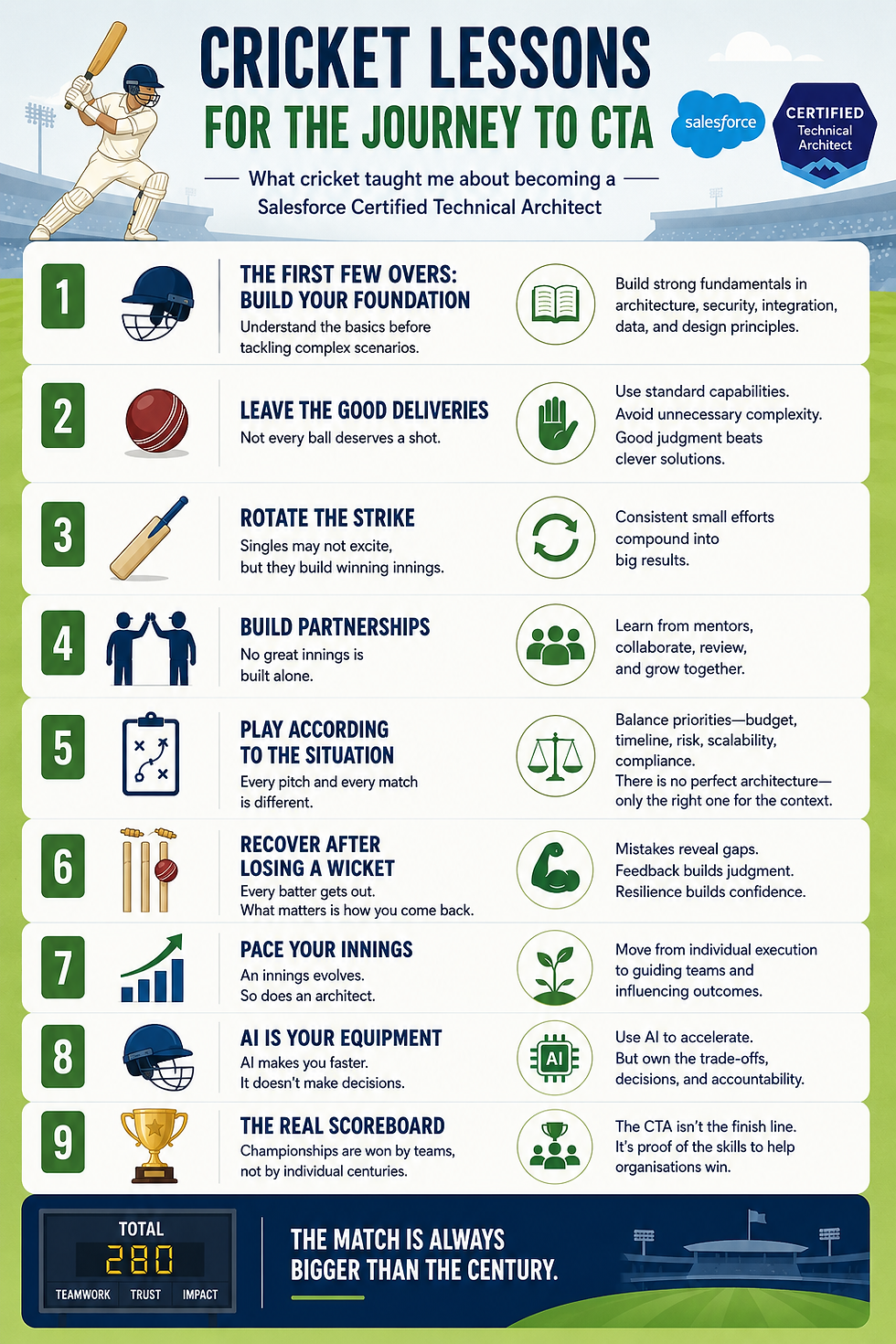
The First Few Overs: Build Your Foundation
Every batter dreams of sending the very first ball soaring over the boundary for six. In reality, the best players rarely begin that way. They spend the opening overs reading the game—understanding how the pitch is behaving, whether the ball is swinging or seaming, how much pace the bowler is generating, and how quickly the outfield is playing. Only after they've assessed the conditions do they start playing with confidence and intent.
The journey to becoming a Salesforce Certified Technical Architect (CTA) follows a remarkably similar pattern. It's tempting to jump straight into mock Review Boards or tackle complex architecture scenarios from day one. But the strongest candidates resist that temptation. Instead, they invest time building a solid foundation—developing a deep understanding of platform architecture, security, integration patterns, data architecture, and the design principles that underpin every successful solution.
Just as a great innings isn't defined by its first delivery, a successful CTA journey isn't built by rushing into the hardest problems. It is built patiently, one concept at a time, until those fundamentals become second nature. When the real Review Board arrives, you're no longer reacting to the questions in front of you—you've already developed the judgment and confidence to navigate them, much like an experienced batter who has spent the early overs reading the game before playing their shots.
Leave the Good Deliveries
One of the toughest lessons cricket teaches is that sometimes the best shot is the one you never play. Watch the world's best batters, and you'll notice they're just as comfortable leaving a ball outside off stump as they are driving one through the covers. They understand that not every delivery deserves a response. Patience and discipline are often more valuable than aggression.
The same principle applies to enterprise architecture. It's easy to be tempted by every new capability or to reach for the most sophisticated solution—whether that's Apex, microservices, Platform Events, MuleSoft, or the latest AI feature. But great architects know that technology should solve a problem, not showcase technical expertise.
The CTA journey reinforces this mindset at every step. The Review Board isn't evaluating how many technologies you can fit into a solution; it's evaluating whether you can make sound architectural decisions. Sometimes the best answer is the simplest one—leveraging standard platform capabilities, reducing complexity, and choosing an approach that is easier to maintain, scale, and support.
Much like an experienced batter who knows which balls to leave alone, a successful CTA knows that good architecture isn't about doing more. It's about knowing what not to do.
Rotate the Strike
Some of the greatest innings in cricket aren't remembered for a flurry of boundaries—they're remembered for how patiently they were constructed. Singles may not excite the crowd, but they keep the scoreboard ticking, build partnerships, and gradually shift the momentum of the game. Over time, those small contributions add up to match-winning performances.
The journey to becoming a Salesforce Certified Technical Architect (CTA) is built in much the same way. Progress rarely comes from a single breakthrough or an intense weekend of study. Instead, it comes from showing up consistently. Read one article. Work through one integration scenario. Review one architecture diagram. Complete one mock Review Board. Each step may seem insignificant on its own, but together they build the knowledge, confidence, and decision-making skills that define a successful architect.
Consistency has a way of compounding. The candidates who earn the CTA credential aren't always the ones with the most experience or the deepest technical knowledge from the outset. More often, they're the ones who commit to steady, deliberate improvement over time. Just like in cricket, it's the accumulation of small, disciplined efforts that ultimately leads to a winning innings.
Build Partnerships
One of the things I love most about cricket is that, despite the individual statistics and personal milestones, it's ultimately a game of partnerships. A memorable innings is rarely built alone. It's the understanding between two batters, the trust they place in one another, and the way they navigate pressure together that often changes the course of a match.
The CTA journey is no different. While earning the credential is an individual achievement, the preparation is anything but a solo effort. Study groups, mock Review Boards, mentors, and peer reviews all play a crucial role in shaping your thinking. Every discussion challenges your assumptions, exposes blind spots, and offers perspectives you may never have considered on your own.
Some of the most valuable lessons don't come from getting the right answer—they come from having your ideas questioned, defending your decisions, and being willing to change your approach when someone presents a better one. That willingness to learn from others is what accelerates growth.
Just as the strongest cricket teams are built on trust and collaboration, the best architects recognize that great architecture is rarely created in isolation. It's the product of diverse perspectives, constructive debate, and a shared commitment to delivering the best outcome. In the end, architecture—like cricket—is, and always will be, a team game.
Play According to the Situation
No two cricket innings are ever the same. Some matches require you to chase a steep target with intent, others demand patience and the discipline to build an innings slowly, and at times, simply staying at the crease becomes the most valuable contribution. The best batters don’t rely on a fixed approach; they read the situation and adapt their game accordingly.
Enterprise architecture follows the same principle. Every customer comes with a different context—budget constraints, delivery timelines, regulatory requirements, legacy complexity, and varying levels of technical maturity. These factors shape what “good” looks like in each scenario and influence the decisions an architect must make.
There is rarely a single “perfect” architecture. Instead, there are always trade-offs, and the right solution is the one that best fits the business context, not necessarily the most technically advanced or feature-rich option.
This is a core mindset the CTA Review Board evaluates. It is not about applying patterns for the sake of it, but about demonstrating judgment—understanding the situation, evaluating options, and designing appropriately within the constraints at hand.
Recover After Losing a Wicket
Every great cricketer gets out eventually. In the same way, every CTA candidate will have a difficult mock Review Board.
There will be moments where a security consideration is missed, an integration pattern is overlooked, or a design decision doesn’t hold up under scrutiny in hindsight. These experiences are not indicators of failure—they are part of the learning process. They surface gaps, challenge assumptions, and sharpen your thinking for the next attempt.
The best players in cricket don’t avoid getting out; they learn from it. They reflect, reset, and return to the crease with better judgment and clearer intent. Similarly, strong CTA candidates use each mock board as feedback, not judgment.
What often distinguishes a successful candidate is not the absence of mistakes, but the ability to recover from them with composure. That resilience, and the willingness to improve after being challenged, is itself a key quality the Review Board is looking for.
Pacing the Innings to Match the Situation
As an innings progresses, a batter’s role naturally evolves. Early on, the focus is on settling in, reading conditions, and finding rhythm. As the innings develops, the emphasis shifts from individual shots to shaping the team’s position in the game. Each decision starts to reflect the match context, not just the ball in front of you.
A Certified Technical Architect follows a similar pattern. Great CTAs are not defined by writing every Apex class, building every Flow, or designing every integration themselves. Their impact comes from guiding teams through complexity, balancing trade-offs, managing risk, and ensuring the solution works as a whole.
As the innings matures, awareness and decision-making become more important than individual execution. The ability to influence outcomes and steer direction becomes the real measure of impact.
AI Is the New Equipment, Not the New Captain
Modern cricket has evolved dramatically. Today’s players are supported by advanced equipment and analytics—high-performance bats, wearable sensors, Hawk-Eye, ball-tracking systems, predictive analytics, and world-class coaching tools. These innovations have made the game faster, more precise, and more data-driven. Yet, despite all of this, they don’t make the decisions.
The batter still chooses whether to attack or defend. The team still decides how to approach a tricky chase. Critical calls on the field remain rooted in human judgment, shaped by experience, conditions, and context—not by tools.
The same transformation is happening in software development with AI. It can generate code, draft documentation, suggest architecture patterns, and even assemble functional prototypes. It significantly boosts productivity and accelerates execution.
However, AI does not own accountability. It does not navigate conflicting business priorities, weigh long-term trade-offs, or earn stakeholder trust. Most importantly, it cannot decide what is right for a specific customer context.
AI enhances the capability of an architect, but it does not replace architectural judgment. It is powerful equipment—but the responsibility of decision-making still firmly remains with the architect.
The Real Scoreboard
Every cricketer dreams of scoring a century. Every architect in the salesforce ecosystem dreams of becoming a Salesforce Certified Technical Architect (CTA). They're meaningful milestones—ones that demand dedication, perseverance, and countless hours of practice.
But with time, you begin to realize that the real measure of success lies elsewhere. A century is celebrated, but what people remember most are the matches and championships that were won. Individual achievements are rewarding, but they matter most when they contribute to the team's success.
The same is true in enterprise architecture. Organizations don't benefit simply because an architect has earned another certification. They value architects who help the business scale without constant redesign, deliver secure and resilient solutions, reduce technical debt, enable faster delivery, and adapt as business priorities evolve.
The CTA credential is an incredible milestone, but it is not the finish line. It represents something far more valuable than passing an exam—it reflects the judgment, leadership, and communication skills needed to guide teams through complexity and help organizations succeed.
Just like in cricket, the match is always bigger than the century. And in architecture, the impact you create will always matter more than the title you earn.


Comments